
This article is general information, not medical advice. If you are worried about your memory, or you have diabetes, talk to your doctor before changing your diet.
Why people ask about dates and the brain
The brain runs our thinking, memory, mood and movement, and looking after it matters more as we get older. Genes play a part. So does how we live: the NHS says there is good evidence that a healthy lifestyle can help reduce the risk of developing dementia, and a healthy, balanced diet is part of that (NHS, dementia prevention).
Dates have been eaten across the Middle East and North Africa for thousands of years, and many families think of them as food for strength and a clear head. Researchers have started to test parts of that belief. Most of the work so far is in mice, and the one controlled trial in people that we found is small and short. Below we set out what dates contain, what the studies tested and what they did not show.
This article sticks to dates and brain health. We look at the same nutrients from a different angle in dates and skincare.
Why brain health matters more with age
As we grow older, it’s natural for cognitive functions such as memory, focus, and mental processing speed to decline slightly. Some slowing is normal. Dementia is different: the NHS says it is not a natural part of ageing, even though the risk rises as you get older (NHS, dementia prevention).
Common age-related cognitive issues include:
- Forgetfulness and reduced memory retention
- Slower information processing
- Decreased attention span
- Increased risk of neurodegenerative diseases such as Alzheimer’s or Parkinson’s
No single food stops this. Dates can be part of a balanced diet, but they are not a treatment for memory loss.
What is in dates
Per 100 g, USDA FoodData Central lists Medjool and Deglet Noor dates at 277 to 282 kcal, with about 63 to 66 g of sugar and 6.7 to 8 g of fibre. In more detail:
- Sugar. Medjool sugar is almost all glucose (about 34 g) and fructose (about 32 g). Deglet Noor has less of each and about 24 g of sucrose.
- Phenolic compounds. Date fruit is rich in phenolics and antioxidants such as anthocyanins, ferulic acid, protocatechuic acid and caffeic acid, according to the Oman research group whose mouse studies are described below (Subash et al., 2015).
- Vitamin B6, 0.17 to 0.25 mg per 100 g. The NHS says adults need about 1.4 mg a day (men) or 1.2 mg (women), and that B6 helps the body use and store energy from protein and carbohydrates and form haemoglobin (NHS, vitamin B).
- Minerals: 656 to 696 mg potassium, 43 to 54 mg magnesium and 0.3 to 0.4 mg zinc per 100 g. The zinc figure is small.
- Fibre. The NHS links a high-fibre diet with a lower risk of heart disease, stroke, type 2 diabetes and bowel cancer, and recommends 30 g a day for adults (NHS, fibre).
One pitted Medjool date weighs about 24 g in the USDA data, so three of them come to roughly 200 kcal and 48 g of sugar.
What the research has tested
Several ways dates might help the brain have been suggested. Here is what has actually been measured, and in which animal or person.
Antioxidant effects in mouse brains
The brain uses a lot of oxygen, and oxidative damage is thought to play a part in Alzheimer’s disease. In a study from Sultan Qaboos University in Oman, mice bred to develop Alzheimer’s-like changes were fed a diet with 2% or 4% dates for 15 months. Their brains showed less oxidative damage and better antioxidant enzyme activity than the same mice on a standard diet (Subash et al., Nutritional Neuroscience, 2015). This was in mice. It has not been shown in people.
Inflammation
Long-running inflammation in the brain is linked to Alzheimer’s disease. In a 2023 rat study, an Ajwa date extract lowered the inflammatory markers IL-6 and TNF-α in rats given a bacterial toxin to make them ill (Shivanandappa et al., 2023). We did not find a human study showing that eating dates lowers inflammation in the brain.
Amyloid in mice
The Oman group also fed the 2% and 4% date diets to the Alzheimer’s model mice from 4 months of age. At 18 months the date-fed mice did better on memory and learning tests, including the Morris water maze, and had lower amyloid beta in their blood plasma than model mice on the standard diet. The 4% diet gave the bigger effect (Subash et al., Journal of Ayurveda and Integrative Medicine, 2015). The authors say dates “may” help lower the risk or slow Alzheimer’s. We found no study that has tested this in people.
Dates and memory
Memory is one of the first things people notice changing with age. The only controlled trial of dates and thinking in people that we found is small and short.
In a 2026 crossover trial, 35 healthy adults aged 18 to 35 ate two Saudi date varieties, Barhi and Khassab, or a placebo matched for sugar and fibre. They then did attention and memory tests over the next two and a quarter hours. None of the overall thinking scores changed significantly. Barhi slowed one reaction-time test compared with Khassab. The authors say the effects were not a general improvement or worsening of thinking, and need repeating (Altuwairki et al., Frontiers in Nutrition, 2026).
The memory gains reported so far come from the mice above. For older adults, no trial has yet tested whether eating dates keeps memory sharper.
Dates and mood
You will read that dates raise serotonin and ease anxiety or depression. We could not find human studies that show this. The 2026 trial did measure mood: Khassab dates raised alertness and lowered calmness for a short time, and Barhi had no effect (Altuwairki et al., 2026).
Dates can stand in for sweets. The NHS says sugar found naturally in fruit does not count as the “free sugars” it wants us to cut down on, but it is still part of the total sugar you eat (NHS, sugar). Dates are high in it, so keep the portion small.
Fibre and the gut
Dates have 6.7 to 8 g of fibre per 100 g, which is good for digestion (NHS, fibre). Research on gut bacteria and the brain is active, but nothing yet shows that the fibre in dates improves thinking.
Dates and neurodegenerative diseases
Alzheimer’s, Parkinson’s, and dementia are conditions associated with progressive brain damage. Here is where the evidence on dates stands:
- Amyloid: lower blood levels in Alzheimer’s model mice fed dates (Subash et al., 2015). Not tested in people.
- Oxidative damage: less in the brains of the same kind of mice (Subash et al., 2015). Not tested in people.
- Inflammation: lower markers in rats given a date extract (Shivanandappa et al., 2023). No human data.
- Parkinson’s disease: we found no study of dates in people with Parkinson’s.
Dates do not cure or prevent these conditions. For lowering dementia risk, the NHS points to the whole pattern of how you live: eating a healthy, balanced diet, exercising regularly, keeping alcohol within recommended limits, stopping smoking and keeping your blood pressure at a healthy level (NHS).
Dates for older adults
Older people often like dates because they are soft, sweet and easy to eat a few at a time. What they can honestly offer:
- a snack with fibre and potassium in it
- something sweet that is a whole fruit rather than a biscuit
- energy from sugar, without caffeine
No trial has shown that a daily handful changes memory or alertness in older people.
Sugar and blood glucose
Dates are sweet, and that sugar counts. In a 2011 study, five date varieties had glycaemic index values of about 46 to 55 in healthy adults, which the authors class as low, with similar results in 10 people with type 2 diabetes (Alkaabi et al., 2011). In the 2026 trial, a portion equal to 115 g of fresh dates did not change blood glucose significantly compared with the sugar-matched placebo (Altuwairki et al., 2026). Dates still raise blood sugar, so portion size matters.
Choosing a variety
No variety has been shown to be better for the brain. Pick by taste and texture:
- Medjool: large, soft and rich.
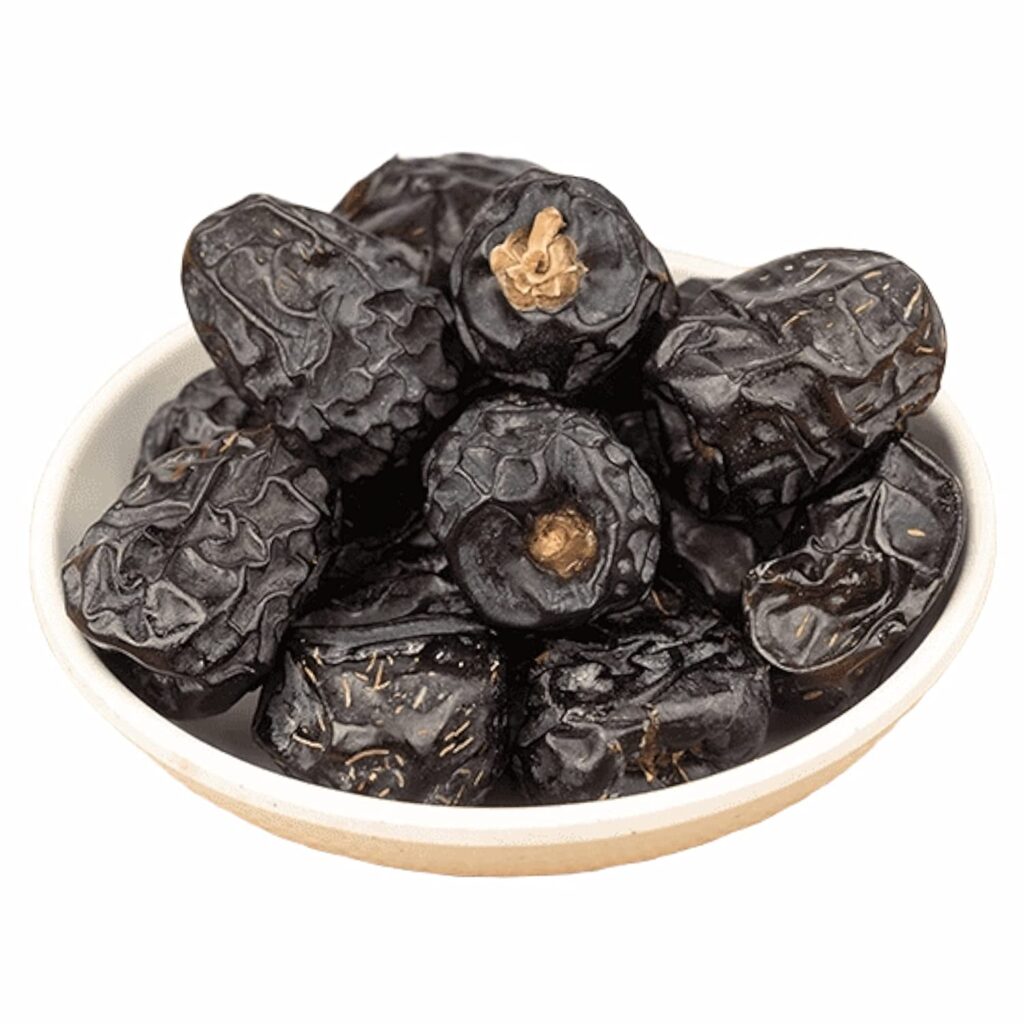
- Ajwa: small, dark and soft, from Madinah, and valued by many Muslims.
- Deglet Noor: firmer and lighter in colour, with a little more fibre than Medjool per 100 g (8 g against 6.7 g).
In Malaysian shops Medjool is usually labelled kurma majol. Ask for that name if you want the large, soft type.
Ways to eat dates
Some easy ways to eat them:
- In the morning, two or three dates with a few nuts.
- Blended with banana, oats and almond milk. Note that the NHS counts sugar in smoothies as free sugar.
- Chopped into a salad.
- As date paste in place of some of the sugar in muffins or bread.
- Stuffed with almond butter or cheese.
Foods that go with dates
Dates go well with:
- almonds or walnuts
- plain yoghurt
- a square of dark chocolate
- a cup of green tea
Eating dates regularly
There is no human evidence that eating a few dates a day for months improves clarity, focus or recall. The longest studies, 14 to 15 months of a date diet, were in mice (Subash et al., 2015).
Moderation and considerations
While dates are highly nutritious, moderation is essential due to their calorie and sugar content.
- Portion: there is no official number. Three Medjool dates are about 200 kcal and 48 g of sugar (USDA).
- Diabetes: count dates as part of the day’s carbohydrate and ask your doctor or dietitian how many suit you (Alkaabi et al., 2011).
- Storage: keep dates in an airtight container so they stay fresh.
If you buy by the carton, our notes on choosing kurma bam suppliers cover what to check before you order.
Other claims: mood, sleep, focus, anxiety
Dates are often said to help with all four. Here is what we found:
- Mood: a short rise in alertness with one variety and no change with the other (Altuwairki et al., 2026).
- Sleep: USDA lists only 7 to 12 mg of tryptophan per 100 g of dates, and we found no sleep trial.
- Focus: none of the attention scores in the 2026 trial improved significantly.
- Anxiety: the date-fed Alzheimer’s model mice showed less anxiety-related behaviour (Subash et al., 2015). There is no human data.
The studies behind this article
These are the studies most often quoted on dates and the brain:
- Subash et al., Nutritional Neuroscience, 2015: date-fed Alzheimer’s model mice had less oxidative damage in the brain (PubMed).
- Subash et al., Journal of Ayurveda and Integrative Medicine, 2015: the same kind of mice did better on memory and learning tests and had lower plasma amyloid beta (PubMed).
- Shivanandappa et al., International Journal of Molecular Sciences, 2023: Ajwa extract lowered inflammatory markers in rats (PubMed).
- Altuwairki et al., Frontiers in Nutrition, 2026: the human crossover trial, which found no general effect on thinking (PubMed).
In short: promising in mice and rats, not shown in people.
Sleep, exercise and nutrition
Exercise, sleep and keeping your mind busy all matter alongside food. The NHS list for lowering dementia risk, given above, is the one to follow.
Culture and science
Dates have been a staple of Middle Eastern diets for centuries, and in Muslim homes they are the usual food for breaking the fast in Ramadan.
Varieties like kurma tunisia are known for their light sweetness and smooth texture, and are often used in traditional desserts and snacks.
The science has not caught up with the tradition yet. The brain studies so far are mostly in animals.
The short version
Dates are a sweet whole fruit with fibre, potassium and phenolic compounds. In Alzheimer’s model mice, a date-rich diet improved memory tests and lowered amyloid and oxidative damage. In the one small human trial, dates did not improve thinking overall. That is what the research on dates and brain health shows so far. Enjoy them as food, in sensible portions, and look after your brain the way the NHS suggests.
References
- Subash S, Essa MM, Braidy N, et al. Diet rich in date palm fruits improves memory, learning and reduces beta amyloid in transgenic mouse model of Alzheimer’s disease. J Ayurveda Integr Med. 2015;6(2):111-20. doi:10.4103/0975-9476.159073. PubMed 26167001
- Subash S, Essa MM, Al-Asmi A, et al. Effect of dietary supplementation of dates in Alzheimer’s disease APPsw/2576 transgenic mice on oxidative stress and antioxidant status. Nutr Neurosci. 2015;18(6):281-8. doi:10.1179/1476830514Y.0000000134. PubMed 24954036
- Shivanandappa TB, Alotaibi G, et al. Phoenix dactylifera (Ajwa dates) alleviate LPS-induced sickness behaviour in rats by attenuating proinflammatory cytokines and oxidative stress in the brain. Int J Mol Sci. 2023;24(13). doi:10.3390/ijms241310413. PubMed 37445591
- Altuwairki D, Watson AW, Brooker HJ, Brandt K. Acute effects of fruit flesh of two Saudi date varieties on mood and cognition in healthy young volunteers: a randomised, double-blind, crossover study. Front Nutr. 2026;13:1733218. doi:10.3389/fnut.2026.1733218. PubMed 42559168
- Alkaabi JM, Al-Dabbagh B, et al. Glycemic indices of five varieties of dates in healthy and diabetic subjects. Nutr J. 2011;10:59. doi:10.1186/1475-2891-10-59. PubMed 21619670
- USDA FoodData Central: Dates, medjool (168191); Dates, deglet noor (171726).
- NHS: Can dementia be prevented?; Vitamin B; How to get more fibre into your diet; Sugar: the facts.